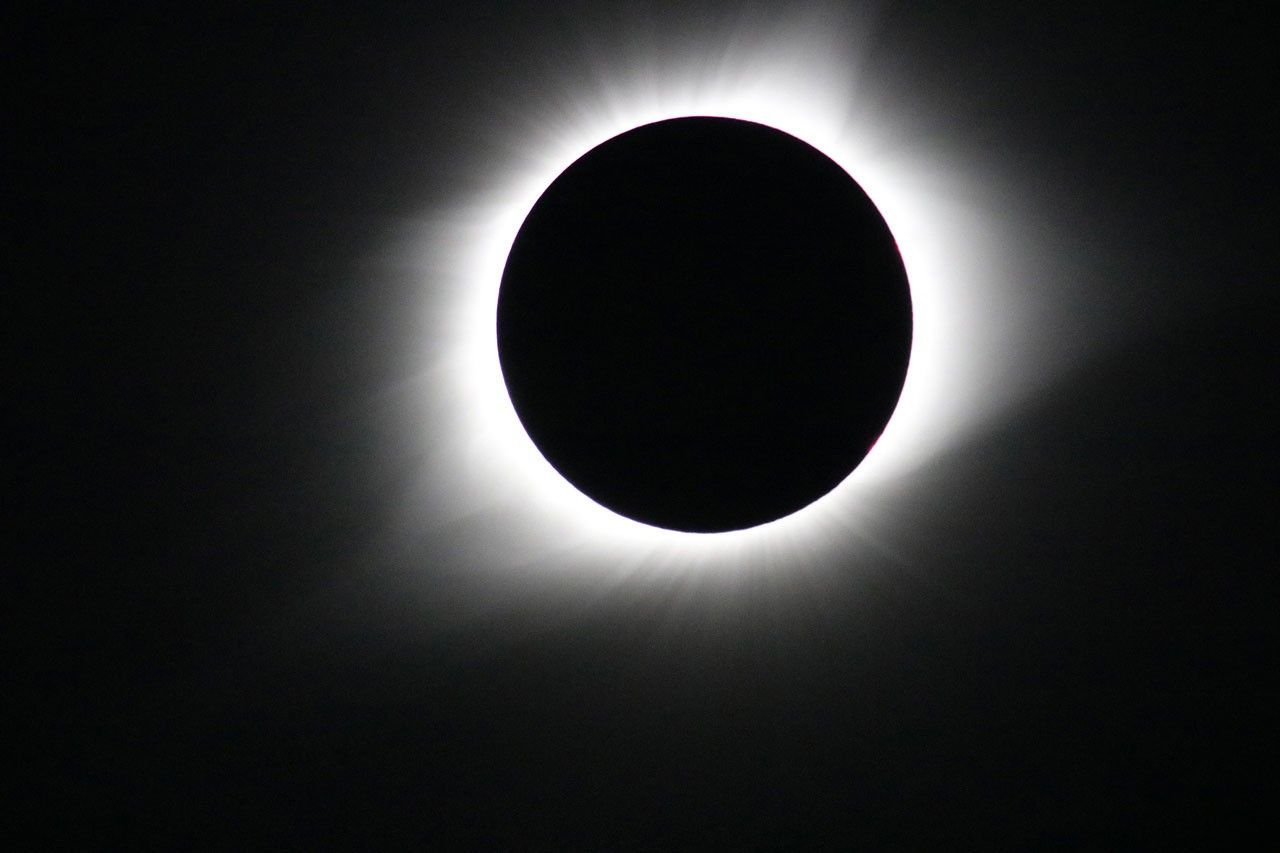
100 days to total solar eclipse: Spain prep status
On 4 May 2026 the countdown to the most-watched astronomical event in modern Spanish history hits a round number: 100 days until totality. On 12 August 2026 the Moon's umbra will trace a roughly 290-kilometre-wide corridor diagonally across northern Spain — the first total solar eclipse to touch mainland Europe since 11 August 1999, and the first to make a Spanish landfall since 1905. NASA's eclipse data and the EclipseWise atlas have been pinning the geometry for years; what changes at the 100-day mark is that planning stops being abstract.
This post takes stock of where Spain stands at T-100: where the shadow goes, what the seven biggest cities in the band actually offer, what the horizon problem means for your viewing spot, and what visitors flying in should be locking down right now.
The path of totality across Spain
The umbra makes landfall on the Galician coast just before sunset and races east across the peninsula in roughly 27 minutes. Along the way it sweeps through six autonomous communities — Galicia, Asturias, Castilla y León, the Basque Country, La Rioja, Aragón, the Valencian Community, and the Balearic Islands — before exiting Spanish territory south of Mallorca and continuing into the Mediterranean.
Seven capital-class cities sit inside the totality band. From west to east:
- A Coruña (Galicia) — first landfall, dramatic ocean setting
- Oviedo (Asturias) — gateway to Picos de Europa
- León (Castilla y León) — Roman city on the Tierra de Campos plateau
- Bilbao (Basque Country) — northern edge of the band
- Zaragoza (Aragón) — longest totality of any major city
- Valencia (Valencian Community) — Mediterranean coast, best forecast odds
- Palma de Mallorca (Balearics) — last landfall, last sunset
Hundreds of smaller towns are also in the band. Burgos, Soria, Tudela, Calatayud, Castellón and Sagunto sit comfortably inside; Madrid, Barcelona, Seville and most of Andalucía are not — those see a deep partial only.
Seven cities at a glance
These figures come from skyalert.io's own city dataset (sourced from USNO timings and AEMET climatology); see the per-city pages for full second-by-second tables.
| City | Totality starts (CEST) | Duration | Sun altitude | Climate odds clear |
|---|---|---|---|---|
| A Coruña | ~20:20 | 1m 50s | 8° | ~50% |
| Oviedo | ~20:22 | 1m 55s | 7° | ~55% |
| León | ~20:23 | 2m 00s | 7° | ~70% |
| Bilbao | ~20:24 | 2m 05s | 6° | ~55% |
| Zaragoza | ~20:28 | 2m 15s | 5° | ~75% |
| Valencia | ~20:30 | 2m 10s | 4° | ~80% |
| Palma de Mallorca | ~20:32 | 1m 45s | 4° | ~85% |
Two things jump out. Zaragoza wins on duration (2 minutes 15 seconds) and has good inland weather odds. Palma has the best climatological clear-sky percentage — but the shortest totality and the lowest sun. Each city has its own page with a per-second timeline; see the Where to watch overview and the city pages for A Coruña, Oviedo, León, Bilbao, Zaragoza, Valencia and Palma.
The horizon problem
Across all of Spain the Sun will be very low — between roughly 4° and 10° above the western horizon at totality. That is unusual for a total eclipse, and it changes how you choose a viewing spot.
A 4° sun is about the width of three fingers held at arm's length. Any tree line, building, hill or distant haze in the western direction will block totality entirely. This is why a beach, a hilltop or an open plain matters more here than for a high-sun eclipse. On the Mediterranean coast — Valencia, Castellón, Mallorca — a beach with an open horizon to the west is ideal. Inland, look for a low ridge or open agricultural land with no obstructions in the western half of the sky.
Practical implication: scout your spot during a sunset on a similar August evening before eclipse day. If you can see the sun set unobstructed, you can see totality. If trees or roofs cut into the lower sun, move.
Weather climatology favours the inland east
AEMET's August climatology gives the inland east — the Ebro valley around Zaragoza and the Valencia coast — significantly higher clear-sky odds than the Atlantic side. A Coruña and Bilbao sit in the 50–55% range; Zaragoza, Valencia and Mallorca are in the 75–85% range.
That said: 100 days out, no real forecast exists. The numbers above are climatology, not weather. Useful actionable forecasts will start appearing in the 7–10 days before totality, and we'll publish updates on those countdowns. What you can do today is build flexibility into your plan — pick a primary spot in the high-odds zone, but know how to drive 60–90 minutes east or west on the morning of the 12th if a frontal system is moving in.
What foreign visitors should plan now
Accommodation. The cities in the band have hotel inventory, but smaller towns along the path — Astorga, Sahagún, Tudela, Calatayud, Sagunto — fill earliest because they're closer to where eclipse-chasers actually want to set up. If you're flexible, book city centres now and downsize closer in. Booking sites are already pricing 11–13 August at premium rates in Zaragoza, Valencia and Palma.
Trains and planes. RENFE's AVE high-speed rail puts Madrid within ~90 minutes of Zaragoza and ~105 minutes of Valencia, which means many travellers will treat eclipse day as a same-day round trip from Madrid. Expect that to fill seats fast. Iberia, Vueling and Ryanair domestic routes into Valencia, Bilbao and Palma will follow the same pattern; pricing typically peaks 4–6 weeks out.
Cars. A rental car is the best insurance against unexpected clouds. Spain's motorway network is in good shape, and the A-2 (Madrid–Zaragoza–Barcelona) and A-3 (Madrid–Valencia) are the workhorses for eclipse weekend. If you plan to drive, reserve early — eclipse weekends in 2017 and 2024 in the United States created near-total rental shortages in chase cities a month before.
Camping and wild. Picos de Europa, the Pyrenean foothills above Jaca, and the Aragonese countryside between Zaragoza and Lleida have municipal campings that are still bookable at 100 days. Sleeping near the path lets you sleep in and shorten morning logistics.
Documents. EU and Schengen visitors need nothing extra. Non-EU travellers should check ETIAS rules, which are due to be in force by August 2026; budget for the small fee and the online application.
Eye safety: the one thing that can't wait
For the roughly 75 minutes of partial eclipse on either side of totality, the Sun is dangerous to look at without protection. ISO 12312-2-certified eclipse glasses are the only consumer-grade solution. Sunglasses, smoked glass, exposed film and welder's helmets below shade 14 are not safe.
Cardboard ISO 12312-2 glasses cost €2–5 each. Pack two or three pairs per person — they are easy to lose, the kids will demand their own, and you'll want spares. Skyalert maintains a curated set of recommended ISO-certified glasses on Amazon — disclosure: that's an affiliate link; we earn a small commission at no extra cost to you. The full safety walkthrough lives on the eclipse safety guide.
A bonus: the Perseids on the same night
12 August also happens to be the peak night of the Perseid meteor shower. Once totality ends and the sky goes properly dark, the new moon (which is what made the eclipse possible in the first place) means there is no moonlight to wash out meteors. From a dark-sky site in northern Spain, expect 60–100 Perseids per hour after midnight. That makes the night of 12–13 August one of the best double-features the European sky offers in the next decade. Details on the Perseids 2026 page.
Set a reminder
100 days will move faster than it feels. The 60-day milestone (13 June 2026) is when accommodation pressure usually accelerates; the 30-day milestone (13 July 2026) is when weather-pattern forecasts start being meaningful. Set a free reminder on skyalert.io/my-reminders and we'll ping you at each major milestone — including the morning-of-eclipse forecast roundup.